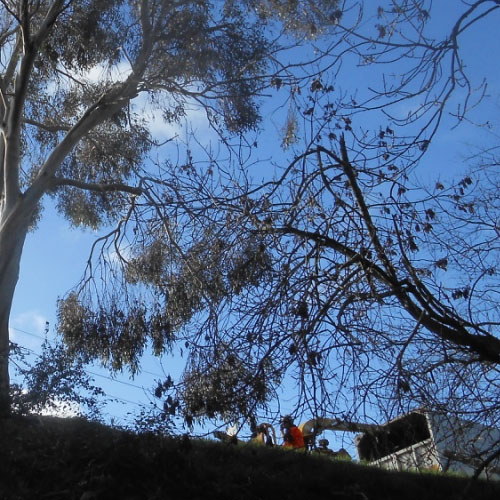
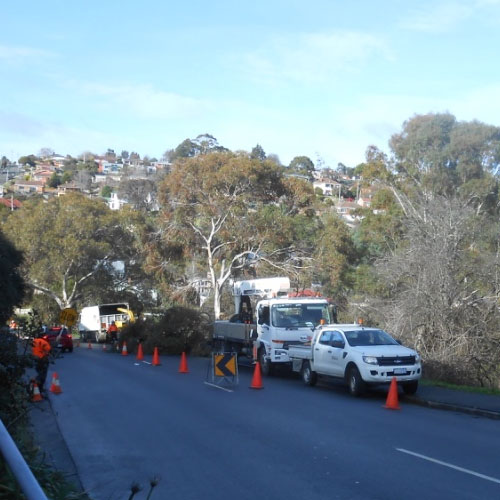
This image comes with a story that has drawn national attention
Tuesday, July 12, 2016
Saturday, July 9, 2016
ALL FOR THE LACK OF A CUPPA: Council Responds To Questions
It seems that the Aldermen in this case at least have been sidelined or are possibly disinterested in the city's cultural landscapes. The notion that 'cultural landscaping' - planning(?) – can be done in isolation and that those implementing planning decisions should be insulated from 'the community' runs counter to the concept of representational governance. To see the State Govt's Good Governance Guide CLICK HERE
Those interested in Trevallyn's, indeed Launceston's, cultural landscape and the management processes that construct it might well be interested in the questions and answers below.
ITEM 7.1.1
City of LauncestonCOUNCIL AGENDA Monday 11 July 2016 3 7.1.1 Public Questions on Notice - Mr Raymond Norman - 11 July 2016 FILE NO: SF6381
AUTHOR: Anthea Rooney (Committee Clerk)
DIRECTOR: Shane Eberhardt (Acting Director Infrastructure Services)
DECISION STATEMENT: The following questions were submitted to Council on1 July 2016 by Mr Raymond Norman and have been answered by Mr Shane Eberhardt (Acting Director Infrastructure Services).
Background: (Officer Comment - Mr Shane Eberhardt) Repair work was required to the 300mm concrete stormwater main in Bald Hill Road. Due to high intensity rainfall early in 2016 and tree root intrusion, the stormwater main has been over capacity and not able to cope with the amount of water flow it experienced. This has resulted in the joints of each section of stormwater main blowing out, creating large voids around the pipe and damaging the footpath, kerb, manholes and road surface, leaving a number of sink holes
To repair the damage to the stormwater infrastructure, three gum trees located over the stormwater pipe have been removed. Removal of the current damaged pipe will be required to allow for the installation of a larger stormwater pipe (375mm diameter) and new manholes to elevate the capacity issues and damage caused by this. Alternative options of directional drilling or lining the existing pipe have been considered but due to the voids around the pipe, it needs to be removed.
There is a significant safety issue with works required immediately to rectify the damage. If delay to the repair work were to occur, there is a high risk of major failure of the stormwater infrastructure, resulting in possible landslips and closure of this section of Bald Hill Road for months in order to undertake the repair. Bald Hill Road is in close proximity to the Trevallyn Primary School and is also a school bus route.
Answers to the specific questions raised by Mr Raymond Norman are shown below. Questions (typed as received)
As a consequence of council management’s action in order to facilitate the installation of a stormwater drain and in regard to the removal of three healthy trees that were 50 plus years old, all of which had local significance, a number of questions arise. In regard to council’s fundament requirement of accountability and it’s obligation to be accountable to its constituents for decisions made on their behalf:
1. Why did council management proceed with only the most superficial commitment to notifying constituents of management’s intention to remove three trees from a cultural landscape? Indeed, in accord with responsible, participatory and inclusive governance why weren’t the constituents in the immediately adjoining jurisdiction – and who would suffer a loss of amenity along with Launcestonians – given an opportunity to present their objections to council in the same way as Launceston Council constituents?
Response: The works were considered urgent due to risk to public safety and advertised in the Examiner which is consistent with all Council works. Neighbours have been consulted as part of construction planning.
2. Given that Bald Hill Road exists at the very edge of the municipality, at the edge of a designated tourist route, within a scenic protection area and within a cultural landscape, why hasn’t much more careful planning consideration been given to landscape protection in the carrying out of this project given the intended and absolutely anticipatable outcomes?
Response: The area where the construction work is required to repair the stormwater pipe is not in the scenic protection area and landscaping has been considered as part of the project. Once the new pipe has been installed and the voids underground filled, the bank will be re-vegetated with more suitable plants/trees.
3. Given the anticipatable community concerns, and the reported budget of $160,000 for the project, why wasn’t the project and its budget referred to the aldermen for their consideration and/or endorsement given the intended outcomes and anticipatable community concerns?
Response: The project was prioritised over other projects within the stormwater program because the road and stormwater pipe had failed and if not repaired in a timely manner could have the potential to be catastrophic on surrounding infrastructure, private property and pedestrians. This area is in close proximity of the Trevallyn Primary School and Bald Hill Road is a school bus route. Aldermen were advised of the works.
4. Given the reported significance of the project, and the range of sensitivities it confronts, why hasn’t management placed a Development Application before the people who use and traverse the landscape in order to have the project considered at an open council meeting?
Response: A Development Application was not required.
5. Given that trees that exist within urban landscapes – cultural landscapes – are routinely given a monitory value, what value/s has/have been attributed to these three trees? If in fact no dollar value has been attributed to these trees, why not? Furthermore, what was the total cost of removing these trees from this landscape and what percentage of the project budget does it represent?
Response:The trees required removal as they sit above the stormwater pipe. The trees will be replaced with a more suitable variety as part of the bank re-establishment once the repair work has been completed
6. Given the expectation that council needs to be representative of, and sensitive to, the needs of the entire community why hasn’t a more diligent effort been made to fulfil this expectation in order to be consistent with council’s planning provisions and policies in regard to the sensitive management of this cultural landscape; this area of implied scenic protection; and this significant urban precinct?
Response:.The works are not in the scenic protection area and are permitted under the Launceston Planning Scheme.
7. Can council demonstrate in any way that its actions relative to this project, and the decision making that has led to it, represents effective and efficient management, indeed best practice, in regard to appropriate 21st Century urban stormwater management given the current state of the Tamar estuary?
Response: The works are to repair a stormwater pipe that has failed and if left without Council intervention would result in significant failure of Bald Hill Road and flooding of properties.
8. Upon what expert advice did council rely in the planning of this project and upon what evidence did council management, in concert with the aldermen, rely upon to ensure that the stormwater management proposal was the most effective; the most cost effective; and the most appropriate within council’s budget constraints?
Response: The Council has appropriate stormwater and infrastructure management knowledge.
9. Given that the stormwater being managed originates almost entirely in the adjoining jurisdiction of West Tamar Council, why didn’t the project managers engage with that council towards finding a shared and equitable solution; a cooperative/collaborative strategy; and more environmentally sensitive outcome in regard to this project?
Response: The stormwater pipe that has failed is a City of Launceston asset, therefore is the responsibility of the City of Launceston to repair along with all other affected assets including the road surface, kerb and channel and the footpath.
10. Given council management’s overt commitment to engage with its constituency and the wider community via ‘social media’, why hasn’t council employed this relatively inexpensive and cost effective communication technique in regard to this project given the benefits social media has to offer in regard to engaging with the community – and especially so in regard to this project – towards seeking an inclusive win-win outcome?
Response: The Council has communicated this project consistent with other capital works and the work is not being undertaken for the sake of improving the aesthetic amenity of Bald Hill Road but to carry out emergency repair work to the underground infrastructure that has failed.
11. What does this project represent in regard to appropriate town planning, administrative transparency and accountable governance towards engendering consensus in both the project’s immediate area and the wider community more generally?.
Response: The project is permitted under the Launceston Planning Scheme and was not a long term planned project. The work that is needed to be carried out is emergency repair work and if not undertaken exposes the community to significant risks.
Sunday, July 3, 2016
CIVIC VANDALISM ON BALD HILL ROAD
CIVIC VANDALISM is the very best that this outcome can
be described as.
Like it is with other manifestations of vandalism it comes about as a consequence of unchecked delinquency and underlying unawareness, inexperience and cultural insensitivity. It’s not like you can point your finger at an individual and the go deal with it all as the ‘problem’ presents itself at every levels, all at once and "all the Bloody time" it seems.
Given the multiple options, the question has to be
asked. If a ‘win’ is available for not just one win-win but several why aren’t
they being looked at ... or even for? If you're being paid a salary without bonuses and the
only way up is to comply ... perhaps that's it. To look like you’re a winner its easy. To learn what
needs/could to be done, that's harder. Much harder!
The problem is a rolling predicament where if you
perform you get short term congratulations that come with long term
expectations, that in turn requires one to develop new skills. That takes time and effort. But it might not earn you any more money. Why do it? Why aspire?
Better to maintain the status quo and
not solve problems you can get away with not solving. Then you will continue to keep
yourself in a manner to which you’ve become accustomed .... relatively risk free.
Then comes the uncomfortable ‘sidelines’ that come 'one’s way' where one can benefit from oiling the wheels of that wagon over there ... so to say. What goes around comes around.
This little exercise in CIVIC VANDALISM comes with a little side benefit to ‘the operation’ in that a “tree” is in fact just so much BLOODY WOOD
CHIP. [LINK]
It becomes expedient to declare a tree as being “in the way”, OR “at the
end of its usefulness/life”, OR “diseased” Or a myriad of things. Evidence is not required! Likewise, neither is accountability it seems!
Also, due to the
lack of knowledge/culture/experience/whatever its not possible to see all kinds
of things that can/should be done even when explained.
While we fail to expect accountability we pay more and
more for less and less! It’s all our own faults!
CLICK ON AN IMAGE TO ENLARGE
The seat of "the problem"
Thursday, June 30, 2016
The Memorial Seat That Once Provided A Resting Place In The Shade On Bald Hill Rd.
As a consequence of the removal of the trees on Bald Hill Road on Tuesday and Wednesday the ‘memorial seat’ has been removed.
Council advises that the seat is temporarily removed while the works occur. It will be reinstated following the works.
As they say,"Watch this space!"
Question's On Notice To Launceston Council
As a consequence of council management’s action in order to facilitate the installation of a stormwater drain and in regard to the removal of three healthy trees that were 50 plus years old, all of which had local significance, a number of questions arise.
In regard to council’s fundament requirement of accountability and it’s obligation to be accountable to its constituents for decisions made on their behalf ... CLICK HERE TO GO TO THE QUESTIONS
Tuesday, June 28, 2016
DEVASTATION ON BALD HILL
This work (vandalism rather) proceeded without a Development Application going council. It does make wonder about Launceston Council commitment to the Minister's GOOD GOVERNANCE GUIDE.
Somewhat intriguingly West Tamar Council had not been contacted by Launceston regarding the available options in regard this matter even though at this point West Tamar Council had formed no opinion. However, they did say IF contacted they would be prepared to work with the City council in looking at options/alternatives. This was encouraging but in quick smart time the City of Launceston's worker turned up with chain saws at the ready.
It’s especially encouraging that there is a local government jurisdiction that is indeed committed to working with communities towards win-win. More so, given that there was advice at a site meeting that your West Tamar Council isn’t (or wouldn’t be) interested in being involved albeit that many West Launceston residents and ratepayers will/would regard the loss of these trees as a loss of their amenity – and for many different reasons.
Whilst This project is a Launceston Council ‘operational matter’ it comes with the impediment of non-engagement with ‘the community’ and the largely untested assertion that they, the community, are “not really interested”. Given that no DA Notice has ever been posted on the site such assertions can only be hollow and they, on the evidence, seem to carry with it the risk of it being a convenient self-serving assertion(?).
STORMWATER MANAGEMENT
Stormwater management in Tasmania is increasingly gaining the attention it needs and even in Launceston Council’s jurisdiction significant gains are being made. It is just the case that in this instance the imperative is, it seems, on the evidence, to move this water through the landscape as fast possible.
This is contrary to what is regarded overwhelmingly as “best practice” in most ‘water-wise’ jurisdictions – albeit that there is sluggishness on the uptake in many instances.
By way of example, Launceston's council expended, and needlessly, a large amount of ratepayers’ money excluding stormwater from the landscape and speeding it on its merry way ultimately to add to the pollution of the river. Thankfully that approach is changing but not yet on Bald Hill Rd it would seem.
Given that you West Tamar Council has now demonstrated that, as a council, it's prepared to talk to Launceston Council one can only hope that in the best of all worlds a win-win for constituents will be found at some time but sadly not now.
![]() |
| CLICK ON AN IMAGE TO ENLARGE |
Thursday, June 23, 2016
TREES: A VALUATION METHOD
INTRODUCTION TO THE THYER TREE VALUATION METHOD
The Thyer Tree Valuation Method was developed in Sydney, Australia during 1984.
It was distributed for public use in 1985 and there have been minor modifications since.
The method is summarised and presented as a one page worksheet for ease of use.
Personnel engaged in tree valuation should be qualified, experienced and knowledgeable in
arboriculture and landscape assessment. They should also be trained in the use of this method.
The method allows the calculation of monetary values for trees. It was designed to value trees on
public or community owned land in city, town and suburban locations. It is assumed that tree values
may be affected by the zoning and permitted uses of the land on which they grow. The method is not
intended for use within bushland areas, or on rural land except near residences.
The valuation is an expression of the positive qualities of the tree, the contribution that tree
makes to the landscape, and the extent to which this is appreciated.
The calculated value is a statement of the importance of the tree to the environment and human
community, not just to the owner of the tree. Owners and neighbours may calculate different values
depending on their opinion of, or problems with a tree. Values calculated for trees on private land
indicate the value of those trees to the community.
Damage caused by the tree, cost to repair that damage, and cost to repair or remove the
tree must be valued separately.
The method combines four factors to establish a Significance Index for each tree :
1. Size measures of height, side view of canopy area, dripline diameter, and girth.
2. Age of the tree.
3. Physical assessment of the tree and location.
4. Social benefit and how the tree is appreciated.
Wednesday, June 22, 2016
WHAT VALUE A TREE?
Indeed how do you value trees? Apparently there are trees on some kind of register at Launceston Council but how they get on the register is a total mystery.
Even more mystifying is how these trees get a dollar value.
Councils these days are populated with all kinds of ‘experts’ but what kind of training might you need to equip you to put a dollar value on a tree – goodness knows.
To be sure there would be a dollar value relative to the timber in it, the fuel in it, the amount of mulch you might be able to recover, the fruit you might be able to harvest, etc. But for a street tree, how do you put a dollar value on them?
If a tree presents a serious risk it is perhaps worth something to someone as income for the 'risk removal'. If the allocated budget for a project is say $160,000 – as it is/was(?) understood that it was/is – the percentage allocated to ‘tree removal’ might well be their value.
Anyway it would be interesting if someone could estimate the value of this particular set of trees on whatever basis.
![]() |
| Apparently this sort of thing takes too much time and nobody cares anyway ... apparently |
Sunday, June 19, 2016
What about tourism amenity?
Launceston's Cataract Gorge is without doubt the city's major 'tourism drawcard'. Therefore cutting down three majestic eucalypt trees on a tourism route would constitute a special brand of vandalism that would exceed by far say any "inappropriate graffiti" along such a route.
Quite aside from being 'inappropriate' here it would represent laziness not to mention the questions it might raise about who might benefit from 'the work'. IF "no one" why do it?
Given that we are in the midst of worldSILLYweek deciding to cut these trees down this week without thinking about it would be an example of HIGH SILLINESS!!
REST AWHILE AND BE THANKFUL AND COUNT YOUR BLESSINGS
![]() |
| THE COMMEMORATIVE TEXT FOR THIS RESTING PLACE IS "REST AWHILE AND BE THANKFUL AND COUNT YOUR BLESSINGS" |
Any idea what species they are as I believe some may well be critical habitat for numerous animal species?
I have also sent an alert to a group of eminent and passionate local naturalists who are also involved the the "Friends of Trevallyn" a volunteer group who undertake valuable work in Trevallyn in local reserves and in association with the local primary school.
I trust that local outrage will snowball to prevent their removal
Cheers
Concerned Citizen
BTW: The trees are approximately 50+ year old Eucalyptus viminalis – Manner Gums ... great habitat trees
Sunday, June 5, 2016
A Cultural Landscape Under Threat On Bald Hill Road
It seems that the idea is in fact that nobody
cares? It also seems that this notion evolved somewhere else in "the
community" and it has been deemed that in this community nobody cared about this
place otherwise why would it look the way it does? Well, this is an untested idea!
So, rather than stir up dissension in order to
complete an allocated $160K project on Launceston's CAPITAL WORKS
PROGRAM (not and emergency project) apparently it was assumed that a DEVELOPMENT
APPLICATION (DA) wasn't required/needed/wanted/appropriate/whatever.
Rather, a single advertisement was placed in The Examiner alerting anyone
who actually saw the advertisement that three trees were going to be removed
along with an invitation to contact Council if anyone had a concern. This site is in response to that advertisement and the 'class of marketing' it characterises.
Well there is a concern about the manner in which a 'cultural
landscape' is about to be "devastated" and more so by the potential loss
of three 50+(?) year old Eucalyptus
viminalis – Manner Gums.
Most concerning is the apparent lack of planning and community consultation
given that these trees exist in what is clearly a landscape with various layers
of amenity attached to it.
However equal to the aesthetic amenity it can be argued that these trees play a
significant role in stabilising the bank upon which they are located. Moreover,
the bank, given that it is the outcome of circa 1950s road construction work for the
Trevallyn Dam. It has become, arguably, albeit by some kind of evolution of land settlement etc., an element in 'stormwater filtration' for
stormwater that ultimately finds its way into the Trevallyn Rivulet – now
enclosed and running under the Trevallyn shops.
Importantly, a large percentage of the stormwater passing through
this area originates in the West Tamar Council area. Also, it is now better understood in civil engineering that returning stormwater to the landscape in urban environments is more and more important.
What is being characterised as a simple management issue here is in
fact more complex and of interest to a diversity of residents on Trevallyn and
in the adjoining West Tamar Council area.
The removal of these trees is reported as being urgent except they
are threatening nothing more than an expedient plan. It is claimed that there
is a plan to replant the bank but no such plan has yet been drawn up and
possibly its not budgeted for either. The mitigation of the loss of amenity seems far from the current imperatives driving the implementation of a plan – arguably an underdeveloped plan.
Clearly it is time to stop, take a deep breath and put a
Development Application up to Council and the people who have various
attachments to, and interests in the place, the trees, the aesthetic amenity of
the area, the better management of stormwater and possibly other things that a
NOTIFIED DA will alert management to.
CLICK ON AN IMAGE TO ENLARGE
Subscribe to:
Posts (Atom)